
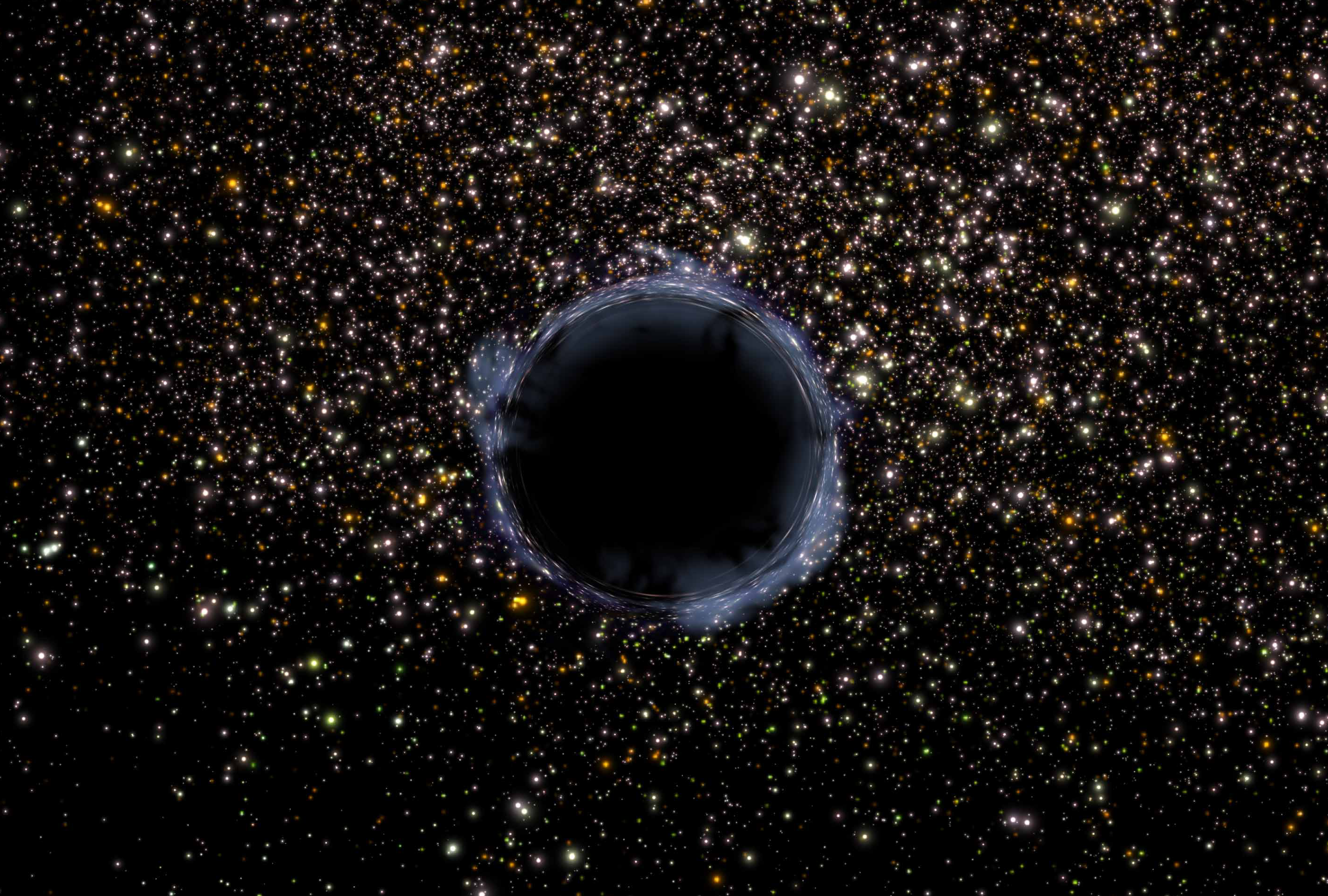
WHAT IS A BLACK HOLE?
The single thought that something so massive, so dangerous and so glutonous can exist out there in the universe has always sent a chill down my spine. Getting anywhere close to it leads to inevitable annihilation. But is there really no way out? And most importantly – what’s inside it?
What is a Black Hole?
- A black hole is a region in spacetime where the gravitational pull is very strong, that even light is not able to escape.
- A black hole can be the final state of a star. When a massive star runs out of its fuel and stops shining, it will start collapsing in on itself. This collapse can eventually lead to a black hole formation.
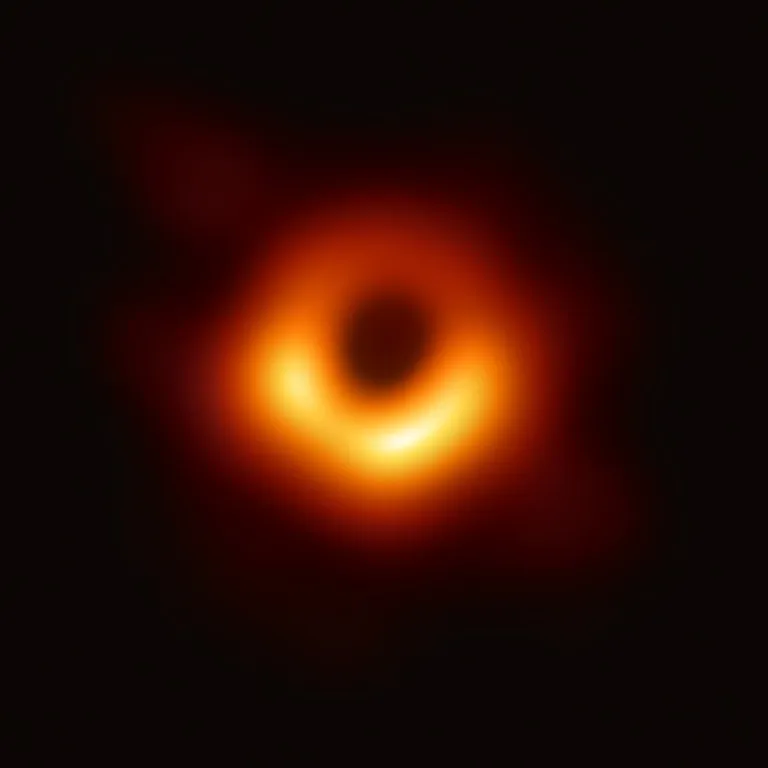
Credits: National Science Foundation/Event Horizon Telescope Consortium
How is a Black Hole Created?
It is difficult to study a black hole formation directly because once a black hole exists, information about its origin cannot easily be observed. A black hole basically destroys its own origin. However, based on theories and observations, scientists believe the following:
- A black hole is created when a massive star runs out of its fuel and starts collapsing in on its own gravity.
- Not every star ends as a black hole. The star needs to have a mass of at least 3 times that of our Sun.
- The collapsing can then explode into a supernova explosion. The remaining core must have a mass of more than about 3 times the mass of the Sun to form a black hole.
In the book Black Holes and Baby Universes, Stephen Hawking explains that when a black hole is created, it rapidly settles down and becomes a stationary object. Black holes are characterised by three parameters:
- Their Electric charge
- Their Mass
- Their Angular momentum (spin)
This idea is known as the no-hair theorem.
How Can We Detect Black Holes?
There are ways to detect if what we are seeing in space happens to be a black hole:
- Measure its Mass – Because black holes are invisible, so we can look at the surroundings and try to detect any unique behaviour . If stars or gas move around a black hole, we can measure their orbital speed and their distance from the black hole. Faster motion of the stars or gas means stronger gravity, which means a larger mass for the black hole. The minimum mass requirement for a stationary black hole is 3 solar masses and must be extremely compact, to deduce any dwarf or neutron star formations from the list.
We can also use other types of methods for measuring the mass of a black hole, such as by Gravitational Lensing. By measuring how much the background light is being bent, it can tell us the mass of the black hole.
- Check if it has an event horizon – We cannot directly observe an event horizon, but we can infer its presence by studying how nearby matter behaves. By comparison, matter falling onto a neutron star releases energy when it strikes the star’s surface, whereas for a black hole no such surface emission is observed, consistent with the presence of an event horizon.
- Electromagnetic Radiation – we also study the radiation emitted by matter reaching us. We study electromagnetic radiation (like X-rays) emitted by hot matter as it falls toward the black hole. This radiation can be detected by telescopes.
What happens inside a Black Hole?
According to general relativity, time and space behave very differently inside a black hole, and our current physics cannot fully describe it.
- The gravitational pull is very strong – so strong that even light, which is the fastest thing in the universe as we know of, cannot escape once it crosses a black hole’s event horizon.
- Inside the black hole, we believe that time does not exist.
We mentioned that nothing can escape the black hole, not even light. Scientists believe that, if we follow Einstein’s theory of General Relativity (a theory about gravity, how it curves and warps space), then inside a black hole, everything seems to cease existence. Nothing, not even dust, remains.
Stephen Hawking and the Uncertainty Principle
Stephen Hawking spent decades studying black holes. While Einstein’s theory of gravity is remarkably successful, it does not include the Uncertainty Principle from quantum mechanics, which Hawking believed was essential to understanding black holes.
The Uncertainty Principle is a theory, which says you cannot know both measurements, the momentum (how fast the thing you are looking at is moving and in which direction) and the position (where is its location) of the particle you are looking at, exactly at the same time. It is a theory that is not included in the theory of Gravity, which Einstein came up with (Einstein was not a big fan of this uncertainty principle, not one bit).
Using this principle, Hawking predicted that black holes are not completely black. Instead, quantum effects near the event horizon allow particles to escape. This process does not involve anything traveling faster than the speed of light.
This predicted emission is known as Hawking radiation.
As of today, Hawking radiation has not been directly observed.
If the theory is right, this might happen. All we need is proof to look at a black hole and monitor its activity, and to verify if Hawking is correct. As of today, we have not recorded any such ‘leaking’ coming from black holes.
What Happens when a Black Hole Dies?
According to Stephen Hawking, black holes are predicted to evaporate over extremely long timescales—far longer than the current age of the universe. We have not seen it yet, but again, the Uncertainty Principle supports Hawking’s idea.
- Have we recorded any deaths of black holes? – No, we haven’t seen a black hole dying.
Facts about Black Holes
- The closest black hole known to Earth: Gaia BH1 (~1,560 light-years away)
- The furthest black hole: a black hole in the galaxy CEERS 1019. It is about 13.1 bln light years away.
- The largest black hole known: TON 618 (billions of solar masses)
- At the centre of most galaxies (including our own Milky Way), there is a supermassive black hole.
- Most black holes that we detected are in a binary system – this means there is a companion, a star, orbiting the black hole.
- In 2019, the Event Horizon Telescope captured the first picture of a black hole. It was a picture of the black hole in galaxy M87.
- To understand black holes, we must understand gravity – and Einstein’s General theory of Relativity.
Did You Know? Irish Science Fact
John Lighton Synge
- An Irish physicist and mathematician and was born in 1897.
- He made several great contributions to various fields of work, including Einstein’st theory of Relativity, geometrical optics, classical mechanics, and more.
- He was one of the first physicists to study the interior of a black hole.
After Karl Schwarzschild found the first black hole solution (1916) to Einstein’s equations, physicists were confused about how the Schwarzschild radius appeared to be a singularity and many believed spacetime literally “ended” there. This confusion stalled serious black hole research for many decades.
Synge carefully analyzed the Schwarzschild solution using. He showed that
- The spacetime curvature remains finite there.
- The divergence at the Schwarzschild radius is not a real physical singularity, but caused by poor choice of coordinates.
- Synge help remove the coordinate illusions and showed that event horizons are regular regions of spacetime, paving the way for modern black hole physics.
Without Synge’s work we might have not advanced as far into understanding our black holes as we are now.
Mysteries about Black Holes:
- What happens at the center of the black hole?
- Is the Hawking radiation real? Can anything escape?
Resources:
- Black Holes and Baby Universes – Stephen Hawking
- Brief Answers to Big Questions – Stephen Hawking
- Facing Eternity – Jonas Enander
- Nothing – New Scientist, Jeremy Webb
Final Note
Thank you, I hope you enjoyed the article. Please note that I carefully research each topic before publishing; however, some facts may change as science progresses. All articles are thoroughly researched and inspired by published books. Resources are listed in every article.
Please be kind, and have a nice day.
Nyx Log, Stardate 26001.01

Leave a Reply