Who Was Isaac Newton?
“No great discovery was ever made without a bold guess.”
-Isaac Newton
Sir Isaac Newton was a brilliant polymath who dedicated much of his life to helping shape the way we understand the universe. In this article, we will cover some interesting facts about who was Isaac Newton, his work, and his laws of motion.
Quick Facts about Isaac Newton:
- Born: 4 Jan 1643 (Old Style: 25 December 1642), Woolsthorpe-by-Colsterworth, Lincolnshire, England
- Died: 31 March 1727 (aged 84), Kensington, Middlesex, England
- Profession: Polymath – Fields: Physics, Mathematics, Natural Philosophy and more
- Known for: Newton’s Laws of motion, Newtonian Mechanics, and more

Newton’s Work on Light
Who was Isaac Newton, you ask? He was a brilliant polymath who helped shape the way we understand the universe. He was a mathematician, physicist, inventor, author, astronomer, and even an alchemist. Talk about productive! In the field of optics, Newton demonstrated that white light can be split into a spectrum of colours.
In the 1660s, he used a device called a prism, a transparent object that disperses light. The prism causes light of different colours to be refracted by different amounts and to leave the prism at different angles, creating an effect similar to a rainbow.
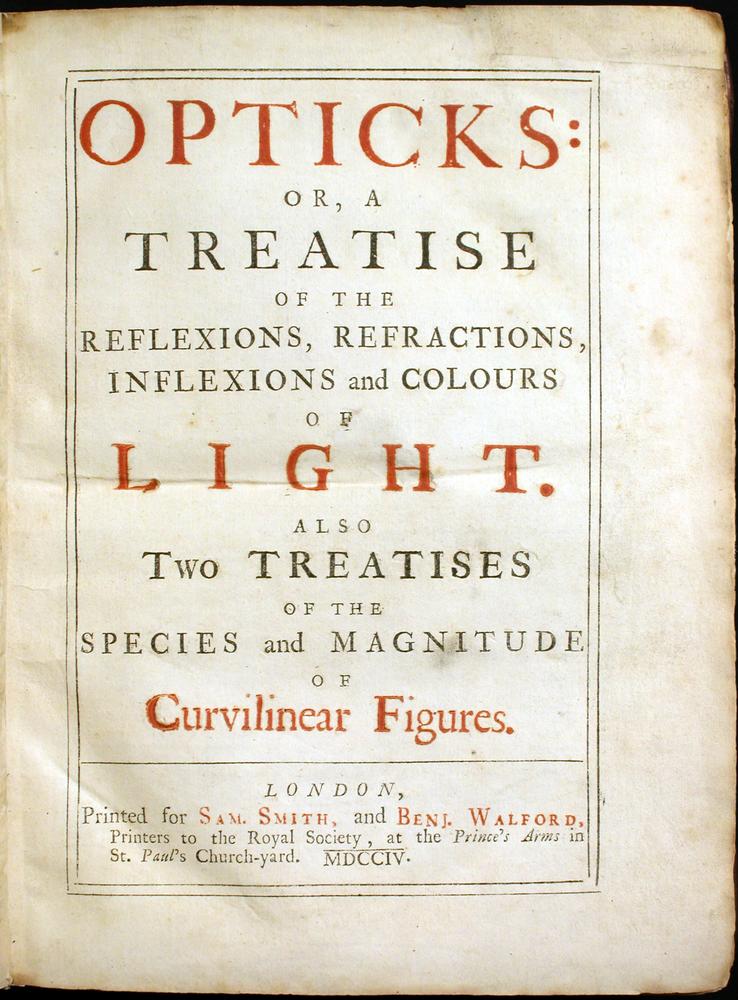
- Newton identified seven colours in the visible spectrum: Red, Orange, Yellow, Green, Blue, Indigo, and Violet — often remembered by the acronym ROYGBIV. In 1704, his work on light was published in his book called Opticks.
Newton’s First Telescope
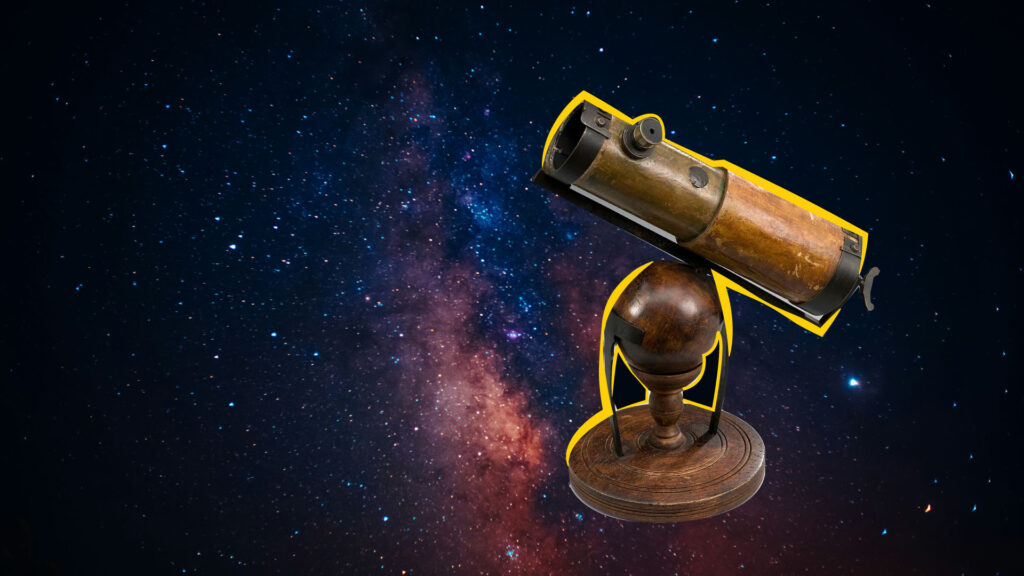
- Thanks to his studies and understanding of light, Newton built the first practical reflecting telescope in 1668.
- A reflecting telescope uses a curved mirror to gather and focus light, whereas a refracting telescope uses lenses. Newton’s design helped solve some of the optical problems found in earlier telescopes and became known as the Newtonian telescope.
Newton’s Work on Motion
Is there more achievement behind the question: Who was Isaac Newton? Yes! And perhaps Newton’s most influential contribution was his formulation of the three laws of motion. These laws describe how objects move when forces act upon them and form the foundation of classical mechanics.
Newton’s First Law of Motion
“A body at rest will remain at rest, and a body in motion will remain in motion at a constant speed and in a straight line unless acted upon by an external force.”
The first law is actually pretty simple. If something is sitting still, it will stay still. If it’s moving, it will keep moving in a straight line at the same speed—unless something else interferes. This law is often called the Law of Inertia because it describes an object’s tendency to resist changes to its state of motion.
Newton’s Second Law of Motion
“The greater the mass of an object, the more force is required to change its motion”
This law is expressed using a formula: F=ma, where force equals mass multiplied by acceleration.
The second law tells us something we’ve all experienced: heavier things are harder to move. To demonstrate this, I can flick a 20 cent coin across a smooth surface. Once I flick the 20 cent coin, it will accelerate and move across the surface. If I apply the same force to a heavier coin, let’s say a 2 Euro coin, it will accelerate less because the 2 Euro coin has more mass.
Newton’s Third Law of Motion
“For every action, there’s an equal and opposite reaction.”
If I push against a brick wall, the wall pushes back against me with an equal and opposite force. But how does this law apply to smaller objects?
Let’s say I push a leaf in a flower pot. Does it push back on me with an equal and opposite force?
The answer is yes. The leaf exerts an equal and opposite force on my hand. However, because the leaf has such a small mass, that force causes it to accelerate much more than it causes me to accelerate.
Where do these laws of motion apply?
Do they apply to everyday life? Are the laws the same in space?
The short answer is yes. Newton’s laws accurately describe the motion of everyday objects and are still used today in engineering, construction, transportation, and even spaceflight. However, in situations involving extremely high speeds or very strong gravitational fields, Newton’s theories are no longer completely accurate.
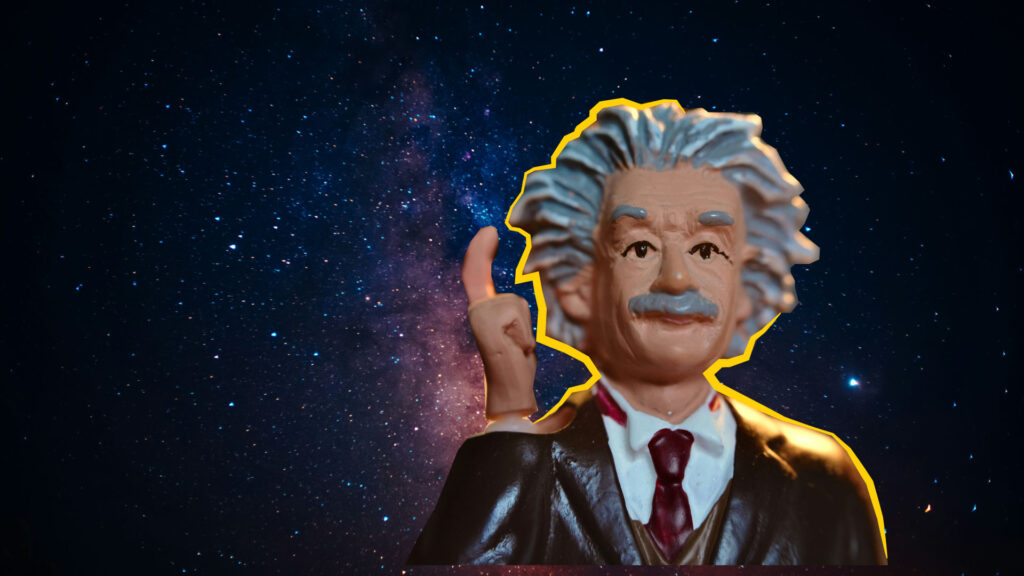
In the early 20th century, Albert Einstein developed the Theory of Relativity, which refined our understanding of space, time, and gravity. Einstein showed that gravity can be described as the curvature of spacetime rather than simply a force acting at a distance.
Did Einstein Correct Newton’s Work?
Short answer is yes – the laws are crucial for everyday objects, like the moving ball experiment we did. But for objects travelling at nearly the speed of light then the formula needs to be replaced by Einstein’s Theory of Relativity. Here is what I’ve learned:
- Before Einstein, scientists had thought what Newton had imagined, that space was flat and empty. So in Newton’s Theory of Gravitation there was nothing in it about warped Space. Therefore, Einstein was trying to find a wat or see if the world he was on was curved, too.” “David Bodanis, Einstein’s greatest mistake – “Einstein’s Greatest Mistake”, David Bodanis
- Einstein proved that this (Newton’s Law) could be wrong, because based on his new equation, planet Mercury would advance in a fashionably order ever so slightly different from what Newton predicted.
As physicist Richard Feynman wrote in his book Six Easy Pieces:
“Newton’s Law of Gravitation is not correct! It was modified by Einstein to take into account the theory of Relativity.”
Summary
- To summarize, Newton’s laws of motion, published in 1687, are still used extensively today.
- For most everyday situations and many engineering applications, Newton’s laws provide extremely accurate predictions.
- However, when dealing with objects moving close to the speed of light or with very strong gravitational fields, scientists use Einstein’s Theory of Relativity.
- One of Einstein’s most famous equations is: E=mc2
- where E represents energy, m represents mass, and c is the speed of light. The equation shows that mass and energy are different forms of the same thing and can be converted into one another.
Who Was Isaac Newton – Bonus Facts
- Family – Newton’s father, also named Isaac Newton, had died three months before Isaac was born. His mother, Hannah, had remarried but Newton disliked his stepfather.
- Farming Future – Somewhere around his teen years, Isaac’s mother removed him from school to become a farmer, but the master and reverend of the school he attended persuaded Isaac’s mother to send him back. He became a top-class student which enabled him to enrol to a university.
- Teaching – Newton was not effective in teaching others. According to Wikipedia, his classes were almost always empty. He did not enjoy teaching, and, over his career, he was only assigned three students to tutor and none were “noteworthy”.
- Books Published: Isaac Newton Published 3 Major Books – Philosophiæ Naturalis Principia Mathematica (1687), Opticks (1704), The Chronology of Ancient Kingdoms Amended (published posthumously in 1728).
- Alchemy: Newton dedicated much of his time to the study of alchemy and biblical chronology, but most of his work in those areas remained unpublished until long after his death.
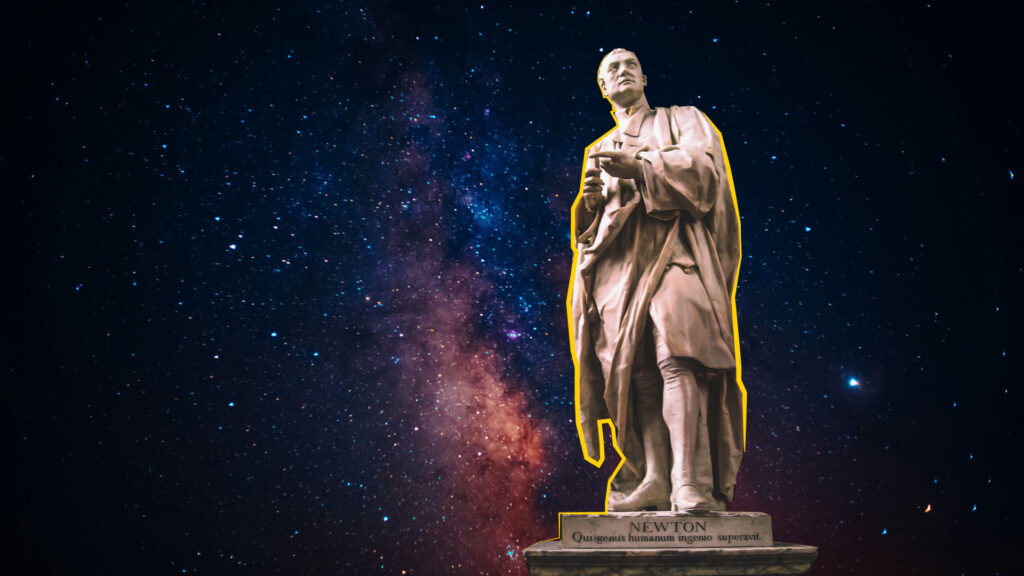
- Burial Ground – Newton died in his sleep and was buried in Westminster Abbey in London among kings and queens. He was the first scientist to be buried in the abbey.
So, what can we take away from all of this?
Sir Isaac Newton wasn’t just the scientist who supposedly got inspired by a falling apple. He was a thinker whose ideas changed the way we understand light, motion, gravity, and the universe itself.
- From explaining why objects move the way they do, to building a revolutionary telescope, Newton’s discoveries helped lay the foundations of modern science. And even though scientists like Einstein later expanded on some of his ideas, Newton’s work is still used every day by engineers, physicists, and even space agencies.
More than 300 years after his death, his influence is still all around us. Not bad for someone who almost quit education to look after the family farm!.
Thanks for reading, I hope you enjoyed this article and that you discovered more behind who was Isaac Newton. Leave a comment if you have any feedback!
Resources:
Books used for article research
- Six Easy Pieces, Richard Feynman
- Almost Everyone’s Guide to Science, John Gribbin
- Pythagoras, Kitty Ferguson
- Einstein’s Greatest Mistake, David Bodanis
Nyx Log, Stardate 260241.1
Thank you, I hope you enjoyed the article. Please note, I carefully research the topic before publishing, however some facts could have changed since publishing this article, so I appreciate your understanding. All articles published are thoroughly researched and inspired by published books. The list of resources are published in every article. Please be kind, and have a nice day.


Nicely explained, even beginners can follow this.