Gravity and Batman – Science Facts in Comics
Comic-book writers have long borrowed ideas from science to enrich their stories. Today, we’re taking a look at some of the science facts in comics. Starting with Batman: Off-World – we’ll examine whether the science behind some of Batman’s observations is accurate – or whether the Dark Knight should spend a little more time reading physics textbooks.
We’ve all heard the story of Isaac Newton and the falling apple. There is no strong evidence the apple actually hit his head, but it’s a nice and popular legend. And most of all, it inspired one of the most important scientific breakthroughs in history.
Long before Newton, great thinkers such as Aristotle, Leonardo da Vinci, and Galileo Galilei attempted to understand why objects fall. Aristotle, writing in the 4th century BC, distinguished between “natural” and “violent” motion, while Galileo performed experiments that challenged many long-held assumptions about falling objects. However, gravity was not described mathematically in a comprehensive way until Isaac Newton published his Universal Law of Gravitation in 1687. Gravity was then described with a mathematical framework.
Centuries later, Albert Einstein devoted many years to understanding gravity, culminating in his General Theory of Relativity in 1915. The theory expands our understanding even further, revealing that gravity is not simply a force but a consequence of the curvature of space-time itself.
Fast Forwarding to Batman and science facts in comics…
Here, we’re going to examine some of Batman’s lines, so if you haven’t read it yet, make sure you do before reading this – I do not wish to spoil the fun for you!

Batman Off-World is a miniseries written by Jason Aaron that tells the story of a young Batman who realizes he isn’t prepared for extra-terrestrial threats. He leaves Earth to train himself against dangers from across the galaxy. The story is a fast-paced sci-fi adventure that explores how Batman becomes ready to protect Earth from threats beyond Gotham.
Skip the article and watch a video if you prefer!
The story is set in outer space, Batman is on the villain’s ship and, for the first time on his own (without Robin), he is experiencing the vast cosmos and in some moments he expresses how lonely he is. DC marketed the series as Batman’s “first-ever adventure in space” by himself.
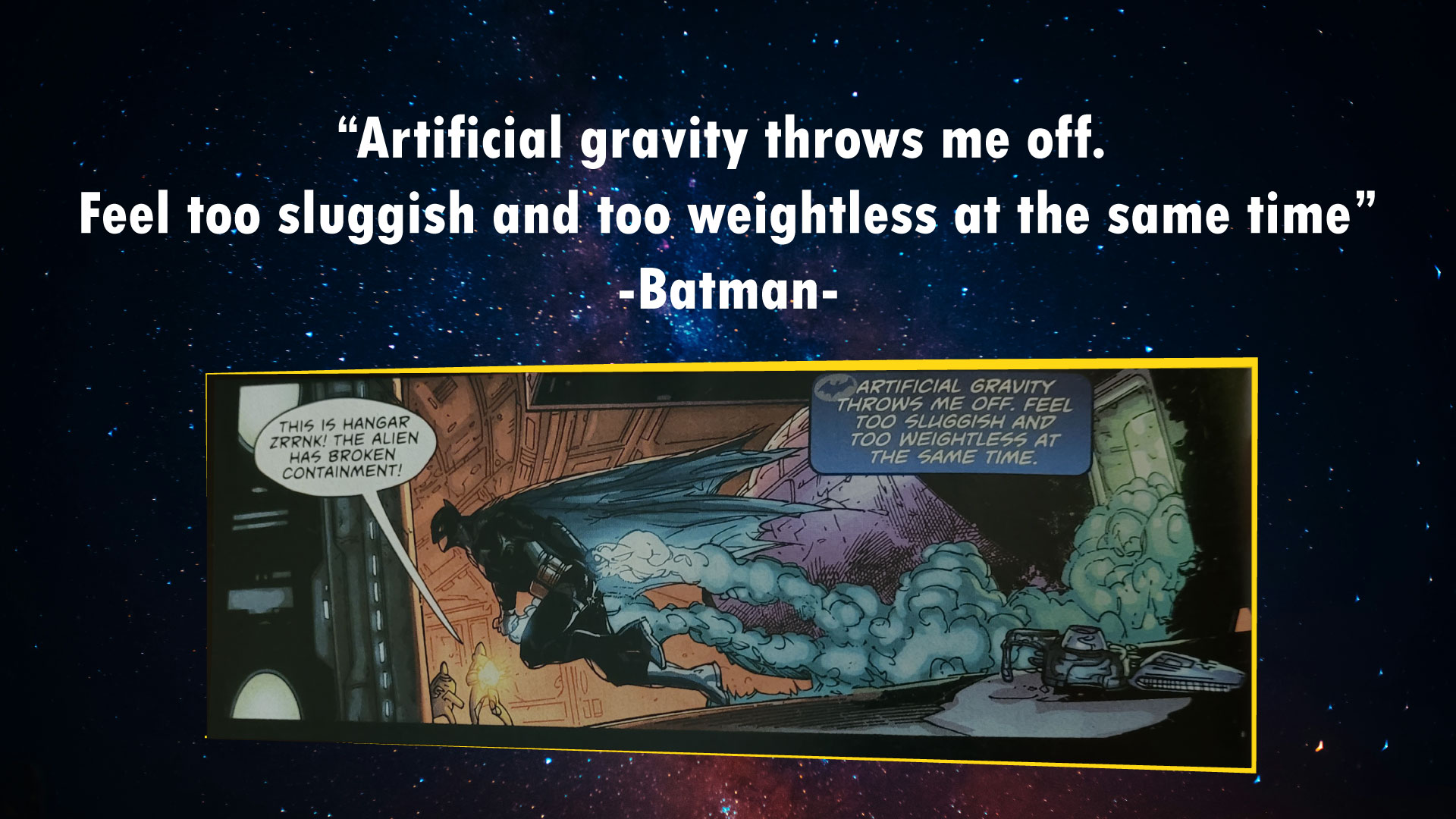
“Artificial Gravity throws me off. Feel too sluggish and too weightless at the same time.”- Batman
Can artificial gravity make you feel sluggish and weightless at the same time? Yes. This is a correct observation by Batman and it is one of the first science facts in comics that we are going to analyze.
According to NASA’s study known as The Artificial Gravity Bed Rest – European Space Agency study (aka AGBRESA), conducted at the German Aerospace Center in Cologne. AGBRESA studied whether artificial gravity could counteract the effects of microgravity on the human body. The adaptation to artificial gravity and rotating environments can cause disorientation, altered movement perception, and unusual sensations that make Batman’s description plausible.
Artificial gravity, or rotational gravity, is the creation of a force known as inertial force. It was proposed to help astronauts withstand extreme space conditions.
Artificial gravity has been proposed as a way to reduce some of the negative effects of long-term weightlessness. It behaves similarly to normal gravity, but with a few differences. Unlike Earth’s gravity, this force is generated by rotational motion rather than by the mass of a planet.
For example, by rotating a spacecraft so that the outward centrifugal effect presses the astronauts against the floor, mimicking the sensation of gravity. The faster the rotation or the larger the structure, the stronger the artificial gravity.
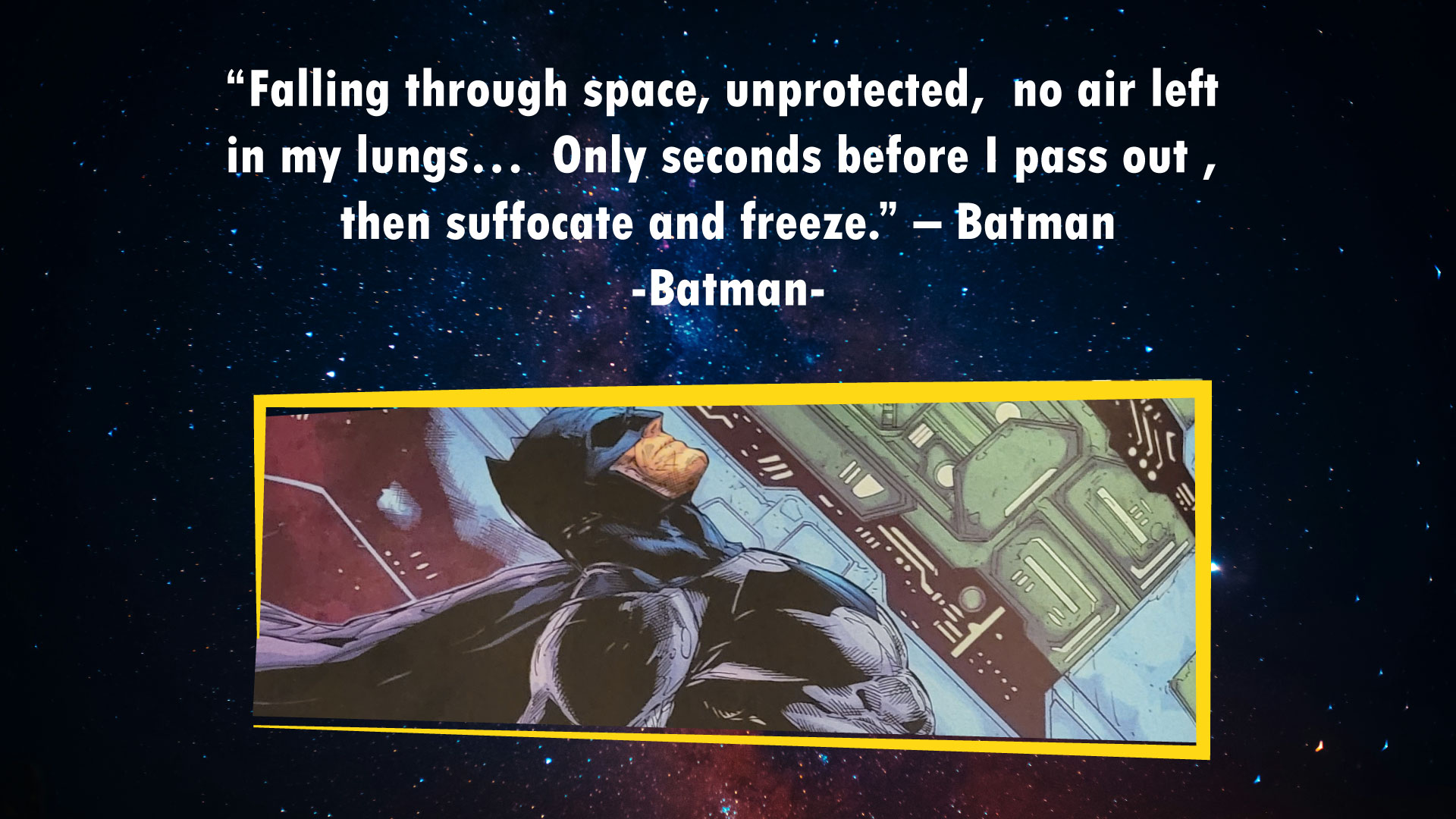
“Falling through space, unprotected, no air left in my lungs… Only seconds before I pass out , then suffocate and freeze.” – Batman
Batman is partially correct here, In a vacuum, Batman would first pass out, then suffocate. But Contrary to popular depictions, he would not instantly freeze.
The Federal Aviation Administration report in advisory circular number 61-107B provides information to aid pilots in becoming familiar with the basic phenomena associated with high-altitude and high-speed flight. Furthermore, it explains how different parts of our body react to different altitudes.
For example, the gas in the Gastro Intestinal tract is usually a result of the digestion process and can escape by either flatulation or belching. But during a flight ascent, If the gas expands iin unpressurized flight to altitude, and is not allowed to escape, it could result in pain and possible syncope, aka passing out.
Humans typically remain conscious for approximately 9 to 12 seconds. The astronaut then starts to lose consciousness due to complete lack of oxygen in the blood, which pumps no oxygen to the brain. All the fluids in the body, including those in the eyes and mouth, start to boil. The gases trapped in body cavities expand, causing swelling and discomfort.
There are other dangerous effects that the spacesuits protect against, such as cold and radiation, but these do not cause immediate death, and they definitely don’t cause explosion.
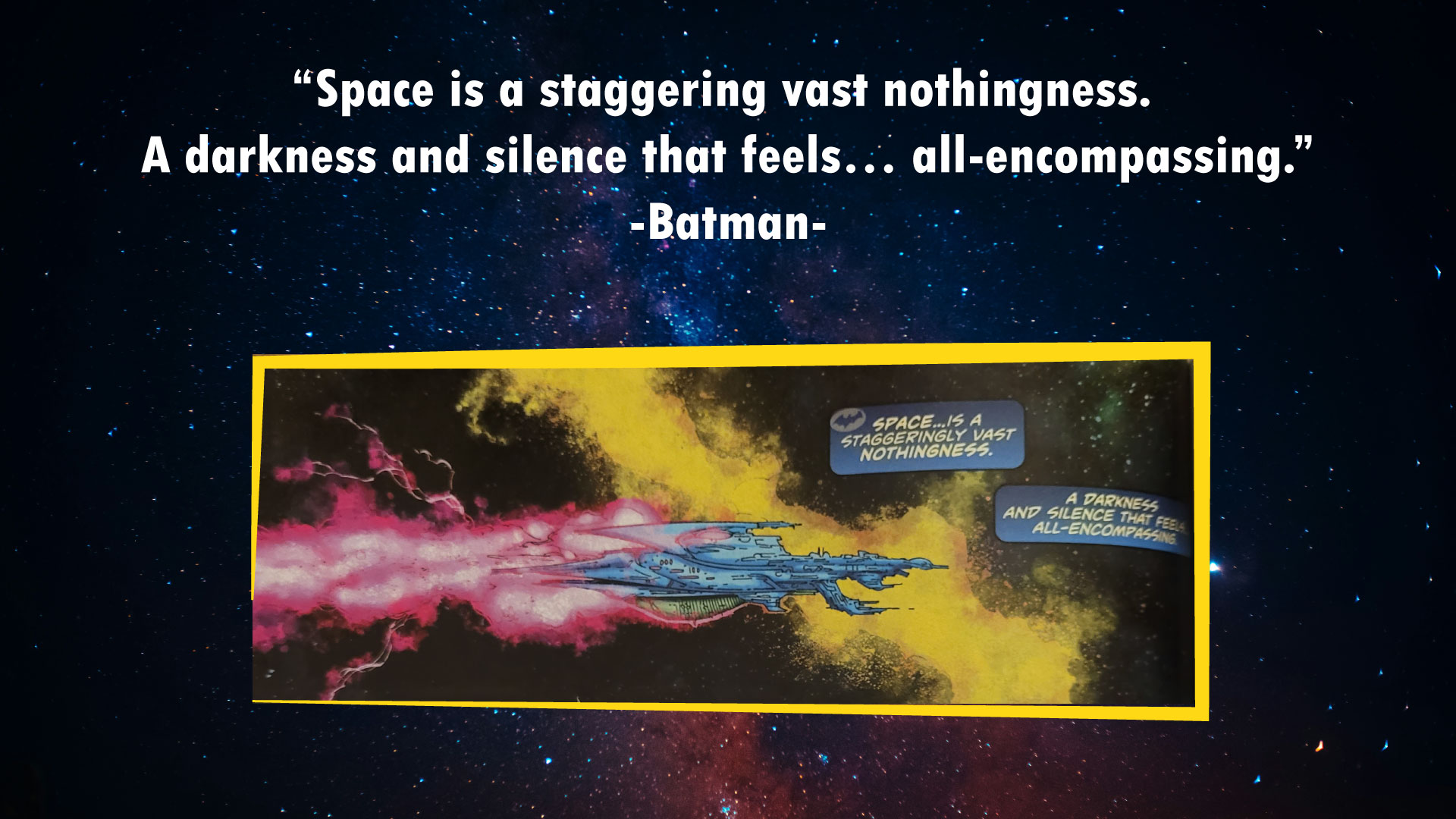
“Space is a staggering vast nothingness. A darkness and silence that feels… All encompassing.” – Batman
Mostly True. Space is unimaginably vast.. It stretches out in every direction, and is expanding at an incredible rate. And it is true that, Aside from stars, galaxies and clusters, the universe is extremely dark. Although much of space appears empty, scientists know that even the vacuum contains radiation, particles, and other forms of energy.
We cannot observe the edge of the universe, assuming one even exists, because light has not reached it yet. Make sure to check out our current observable universe. This image is our 360 view of what is around our planet as far as we can see. To put it in numbers:
- Age: The universe is approximately 13.8 billion years old.
- Radius: Because space has been expanding, light that has traveled for 13.8 billion years originated from a region that is now about 46.5 billion light-years away.
- Diameter: The observable universe spans roughly 93 billion light-years.
Is it silent? Yes. In order for the sound to travel, it requires a physical medium through which to travel. On Earth, sound waves can travel through gases, liquids, and solids. In space, in areas between galaxies or clusters there is very little matter. Sound cannot travel effectively because the density is far too low. So yes, Batman is experiencing a silent universe and is one of the correct science facts in comics.
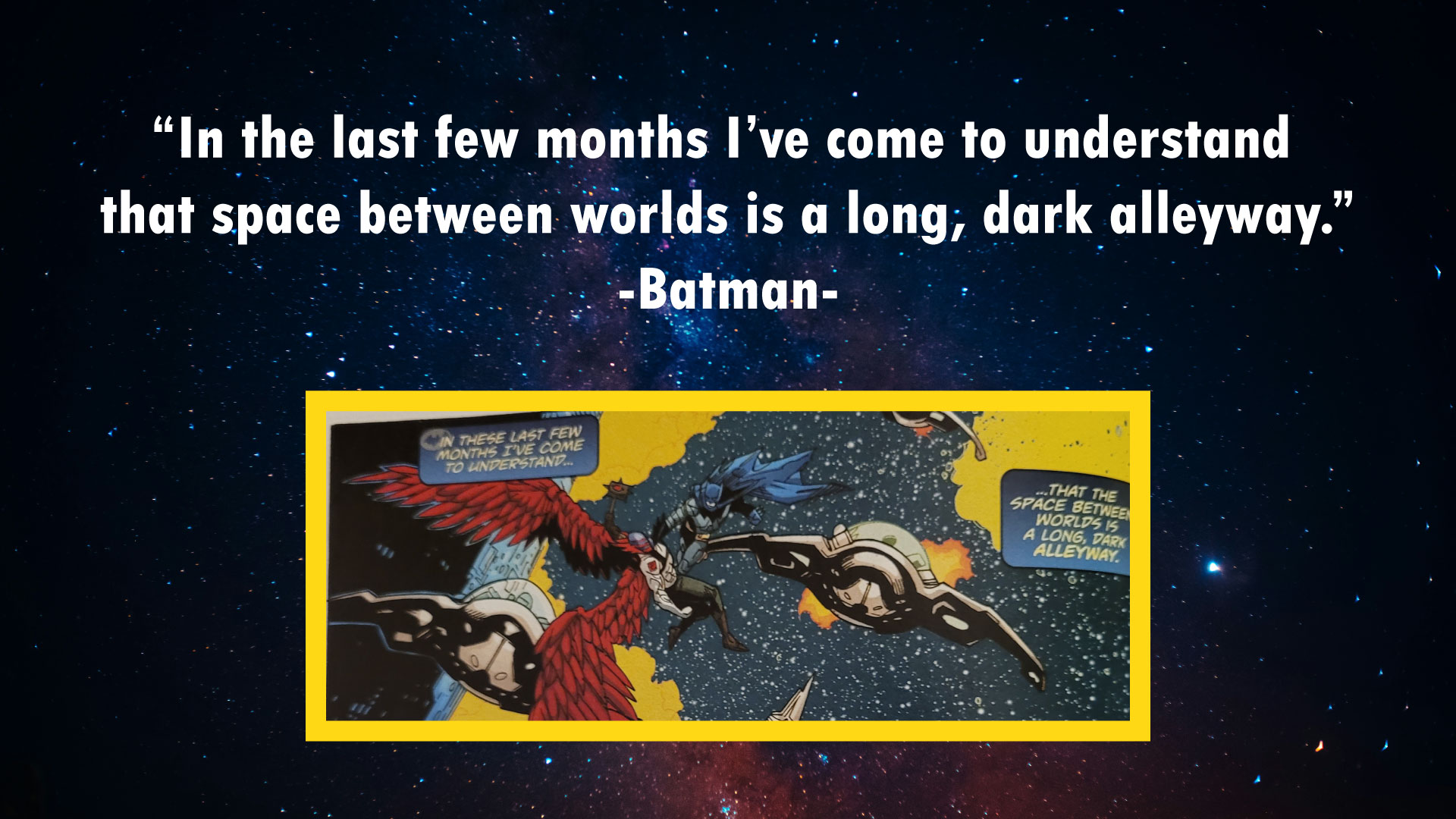
“In the last few months I’ve come to understand that space between worlds is a long, dark alleyway.” – Batman
Partially true, this might be considered more as a metaphor. True, the space between planets is long and dark. Batman fights most of his crimes in dark alleyways in Gotham City. He expresses a nostalgic memory of his hometown. Gravity continues to fascinate us. It shapes galaxies, keeps our feet firmly planted on Earth, and occasionally causes superheroes to have a very bad day.
I really enjoy stumbling on science facts in comics that include some fascinating science facts. Not everything scientific mentioned in comic books needs to be true, right? It is science fiction, after all.. But I enjoy examining them and I hope you enjoyed this article. Leave a comment if you have any thoughts!
Resources
- Batman Off-World written by Jason Aaron to study our science facts in comics
- AGBRESA Study – NASA study incl. artificial gravity
- Observable Universe image – Wikipedia, artist’s impression
- 61-107B Report – By FAA
Nyx Log, Stardate 26006.19
Thank you, I hope you enjoyed the article. Please note, I carefully research the topic before publishing, however some facts could have changed since publishing this article, so I appreciate your understanding. All articles published are thoroughly researched and inspired by published books. The list of resources are published in every article. Please be kind, and have a nice day.



https://shorturl.fm/0O8Ke
I was skeptical at first but this platform is legit. The customer service is very helpful and the withdrawal process is quick. Give krmmwin a try if you want a reliable site.
I’ve been looking for a reliable spot to play and this one really delivers. The interface is smooth and the payouts are quick. Definitely check out joya9combdlogin if you want a hassle-free experience.
The live dealer games here have such a chill atmosphere. I love how the hosts keep things fun and the betting limits suit both casual players and high rollers. My wins get processed quickly and I always feel respected. Check br9nbetvip for a great time br9nbetvip
Found this site through a friend and it did not disappoint. The customer support is very responsive and helpful. Keep it up phjiliuu!
As someone who loves everyday basics, loved this post — this saved me time.