Gravity and Batman
We’ve all heard the story of Isaac Newton and the falling apple. There is no strong evidence the apple actually hit his head, but it’s a nice and popular legend. And most of all, it inspired one of the most important scientific breakthroughs in history.
Long before Newton, great thinkers such as Aristotle, Leonardo da Vinci, and Galileo Galilei attempted to understand why objects fall. Aristotle, writing in the 4th century BC, distinguished between “natural” and “violent” motion, while Galileo performed experiments that challenged many long-held assumptions about falling objects. However, gravity was not described mathematically in a comprehensive way until Isaac Newton published his Universal Law of Gravitation in 1687. Gravity was then described with a mathematical framework.
Centuries later, Albert Einstein devoted many years to understanding gravity, culminating in his General Theory of Relativity in 1915. The theory expands our understanding even further, revealing that gravity is not simply a force but a consequence of the curvature of space-time itself.
Comic-book writers have long borrowed ideas from science to enrich their stories. Today, we’re taking a look at Batman: Off-World and examining whether the science behind some of Batman’s observations is accurate – or whether the Dark Knight should spend a little more time reading physics textbooks.
Batman Off-World is a great comic book where Batman is in outer space. The graphics are unique and the overall story is fantastic. Now, if you haven’t read it yet, make sure you do before reading or watching this content (I have a YouTube video of this article), because I will be taking science quotes from the comic book and analysing them here. OK, so back to the story – the story is set in outer space, Batman is on the villain’s ship and (perhaps for the first time) he is experiencing the vast cosmos and in some moments he expresses how lonely he is. Let’s go over the comic book and verify whether the science facts mentioned are true or false.
The first is this:
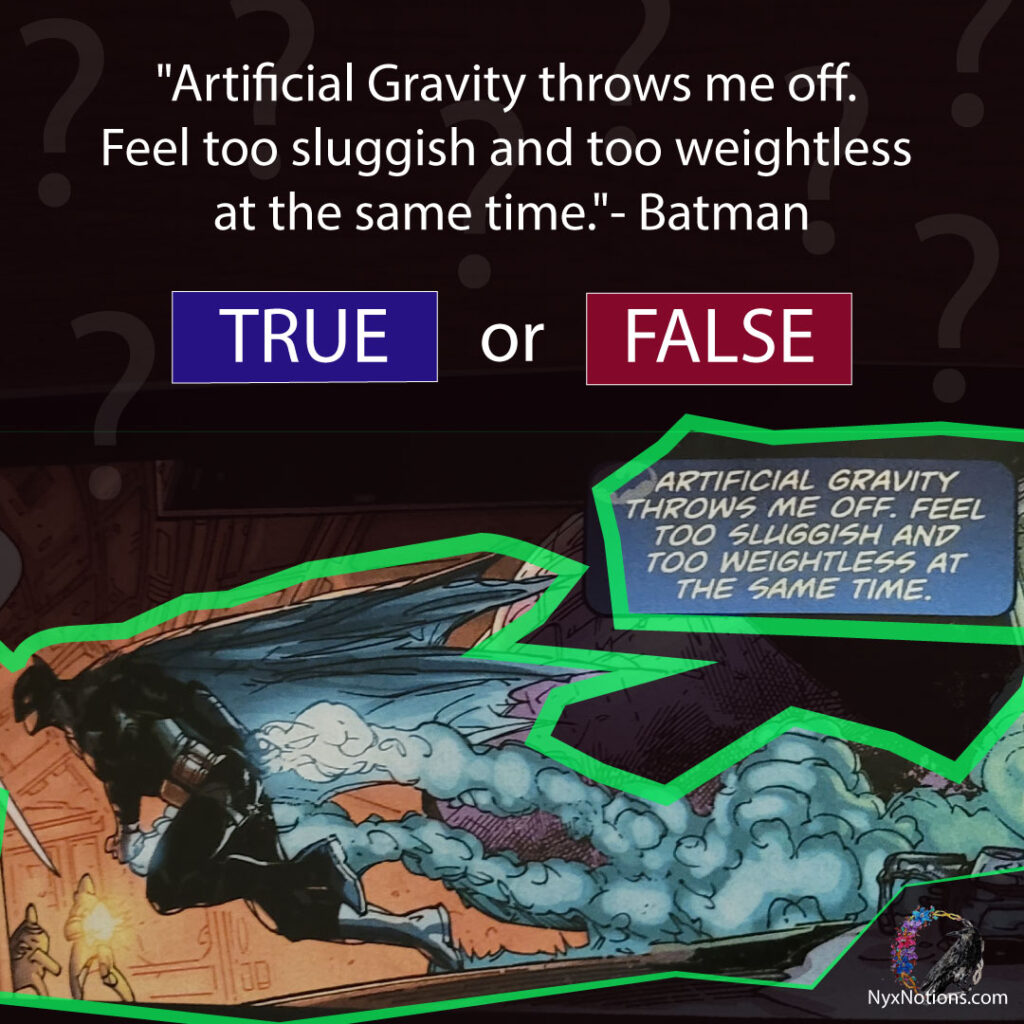
“Artificial Gravity throws me off. Feel too sluggish and too weightless at the same time.”- Batman
This is true. In this example, Batman infiltrates an alien spaceship in the Slag Galaxy. He’s using and artificial gravity to help him adjust to the new environment, while keeping his feet planted on the ground. And you can actually feel sluggish and weightless. If Batman is turning his head abruptly it could trigger a “cross-coupled illusion,” which rapidly induces a tumbling sensation, and sluggishness.
Artificial gravity is produced in spaceships to allow humans go about their space tasks, while feeling an Earth-like environment. Artificial gravity is usually produced through acceleration or rotation rather than by generating actual gravitational fields. Rotational simulated gravity has been used in simulations to help astronauts train for extreme conditions.
For example, one of the human spaceflights, Gemini 11, artificial gravity was attempted to be tested. The astronauts were able to generate a small amount of artificial gravity, about 0.00015 g, but not enough to be felt by either astronaut. However, objects were observed moving towards the “floor” of the capsule.
“Falling through space, unprotected, no air left in my lungs… Only seconds before I pass out , then suffocate and freeze.” – Batman
Batman is unfortunately correct. Being ejected into space without a suit is one of those experiences that can only happen once. You’ll lose consciousness within seconds as oxygen runs out, though Hollywood is wrong about one thing: you won’t instantly freeze into a human-shaped ice cube. A person exposed to space would lose consciousness after about 10–15 seconds due to lack of oxygen. Batman is correct here, you would first pass out, then suffocate. Contrary to popular depictions, he would not instantly freeze or explode. The Federal Aviation Administration reports in advisory circular 61-107 that humans remain fully conscious and useful for 9-12 seconds after being exposed to a vacuum. There are other dangerous effects that the spacesuits protect against, such as cold and radiation, but these do not cause immediate death, and they definitely don’t cause explosion.
“Space is a staggering vast of nothingness. A darkness and silence that feels… All encompassing.” – Batman
True. Space is a staggering vast of nothingness, it stretches out in every direction, and is expanding at an incredible rate. The expansion of space can cause extremely distant galaxies to recede faster than light due to the expansion of space itself. We cannot see the edge, whether or not there is one, because light has not reached it yet.
Is it silent? Yes. In order for the sound to travel we need something that will help the sound travel from one place to another. We need a physical medium. On Earth, the sound waves can travel through matter like air, liquid, gas or other solids. In space, in areas between galaxies or clusters there is very little matter. Sound cannot travel effectively because the density is far too low.
In the last few months I’ve come to understand that space between worlds is a long, dark alleyway.” – Batman
This might be considered as a metaphor. True, the space between planets is long and dark. Batman fights most of his crimes in dark alleyways in Gotham City. He expresses a nostalgic memory of his hometown. Gravity continues to fascinate us. It shapes galaxies, keeps our feet firmly planted on Earth, and occasionally causes superheroes to have a very bad day.
I really enjoy reading comic books that include some fascinating science facts. It’s a well-balanced formula, combining art with science. What did you think of the comic book? Make sure to check out my other articles for more fun.